Showing posts with label speculative fiction. Show all posts

Friday, March 8, 2013

Literary vs. Commercial: A Panel Report from AWP 2013

Yesterday, I went to a talk on bridging the gap between “commercial” and “literary” novels. The speakers (Ed Falco, Julianna Baggott, Lisa Haines, and Benjamin Percy) were phenomenal. They were the kinds of writers you want to be friends with so you could sit over beers late at night talking about favorite books. They were all that a panel should be—funny and insightful, approachable but authoritative—and they made a number of comments that I’ve been mulling over ever since. For example, I liked Ed Falco’s point that we should not be judging books by genre but by quality. He rightly argued that there are badly written literary genre books and well-written commercial ones, and that the quality of goodness or badness in the writing itself (rather than genre) should determine how we judge it. He said that the text, once done and sent to the publisher, is not inherently “literary” or “commercial.” It’s the author’s attitude when writing the book that puts it there. If you’re thinking only about your needs as an author and what you feel you must write, you are writing from a literary impulse, but if you are thinking about the audience and how the book might appeal to them, then your impulse is commercial.

Perhaps it is because I agree with him that I found the question and answer portion of the talk to be a bit frustrating. A young writer behind me asked about how the literary/commercial distinction affected the writing of the book—a good meaty process question—and the panelists (I want to attribute this answer mostly to Haines and Baggott, but more might have chimed in) responded that you write what you feel you must write, ignoring the generic question altogether. I am sure this answer feels utterly true to them, and I’m also sure that it is the best answer available, but I have to say, I can’t help but recognize it as an oversimplification. After all, anyone who has written creatively has faced the wealth of artistic choices, each beckoning with its own siren song. We have ridden through the yellow wood and faced, over and over again, the divergent paths. Sometimes, the street signs on those paths might as well be labeled “commercial” and “literary.” They lead us to different ends, but it isn’t always clear which is the better path.

Let’s be honest: our choices determine the book’s audience and the level of respect it earns with The New York Times book review or, as Haines pointed out, a tenure committee. Haines and Baggott both said that their most commercially successful books were left off their academic CVs or listed as supplementary to their other work because they knew those books would hurt rather than help their cause, and failure to make tenure means the loss of a job and the primary means to feed the family.

I’ve been at the cross roads with my second novel now for the past few months, trying to decide exactly how gritty, how “real,” I want this book to be, knowing that making it too gritty may not appeal to young adult readers who are likely to be its primary audience. The creative genies have yet to come to tell me which path I should take, and this fence rail has long become uncomfortable.

Who was it who said “the truth is rarely pure and never simple?” That’s the message I wish the panel had given the young writer in the audience struggling at her own crossroads. And maybe if they hadn’t been on the spot, under pressure to give the quick answer, they would have. Or maybe I am projecting too much. Maybe the choices have always been clearer for them. Haines and Baggott, after all, are talented and prolific—far more so than I am. Maybe they don’t get stuck on these questions as I am and have been. Maybe they don’t wallow in indecision. Maybe that’s the heart of genius.

Since I am not a genius, though, I will simply say this to that fellow writer and struggler who asked her bold question: many of us share your doubt. The answer Baggott and Haines gave is undoubtedly right—we must determine the road by being true to our work. Yet I come back to Falco (silent during this portion of the Q&A) who said that it is during process that we find ourselves following a literary or commercial impulse. Sometimes, those two masters give contradictory orders, and the writer must determine which s/he serves. The choice is rarely pure and never simple.

Friday, January 25, 2013

The Next Big Thing, continued


This week, I'm passing "The Next Big Thing" torch to Kirsten Kaschock, whose book Sleight is one of my favorite novels published in the last few years. The world Kaschock creates here is our own touched with a surrealistic feathering. Inhabiting this landscape are Lark and Clef, two sisters who dance in a Sleight troupe, an invented art form in which dancers create intricate architectures and sometimes disappear, or "wick," from the stage. When the sisters are confronted with the news of the mass murder of children, they are left to navigate the turbid question, what is the proper artistic response to horror? Would creating a dance that responds to this atrocity be exploitative, or cathartic, or something else, something wholly unimagined?

Kaschock has published two collections of poetry in addition to this thoroughly gripping novel, and her language sings in every line. She is the rare writer whose mastery of stunningly gorgeous word choice, rhythm, and syntax does not soften the harshness of the ideas she explores. She doesn't flinch from difficult questions, but instead finds the images and narrative that allow us to question with her. I'd love to put a copy of this book in every reader's hands.

For more on Kirsten, her work, and her "The Next Big Thing" interview, check in at https://kaschock.wordpress.com/

Find her books here:
Sleight
Unfathoms
A Beautiful Name for a Girl

Tuesday, April 10, 2012

A Dragon For Spec Fiction: It's been a good semester, my loves

This semester, I ventured into terra incognita. Worlds unknown and becoming known. I dabbled with magic systems, mingled with strange races, and wielded sharp blades. In short, I taught my first course on writing the speculative fiction novel. Tonight, it came, with the semester, to a bitter sweet end. These students wrote their hearts out this semester, spilling them drop by drop onto the page in the best of all possible ways. They wrote with the passion of the faithful. (There was a curious lack of dragons, but we'll let that pass.)

I've loved teaching this class, which is interesting given its history. The course has never been offered before because, though the department knew there was student interest, no faculty member particularly wanted to read multiple chapters from early drafts of speculative novels. That's just not their bag, baby. And I understand their position. I, too, am a fan of literary fiction. It's what I write and it's what I read, but I think there's something to be said for teaching speculative fiction. So I'm going to say it.

A quick list, as it were, of just a few things writing spec fiction brings out of the students:

1) Passion. The students who took this class were a self-selected group. Many have been working on spec fiction novels from their early teens. These writers were absolutely committed to the job of writing, and dedicated to finding the awesome in their stories. Their passion rejuvenated mine as well, reminding me that, after all, finding the awesome in any story *is* what it's all about.

2) Knowledge. When I teach a standard literary fiction writing class, part of my job is to educate the students about the writing that's out there. Most of the literary writing students know is dated (Faulkner, Fitzgerald, Hemingway), and I have to bring them up to speed with recent trends--something that's difficult to do in a semester when I'm also trying to teach basic writing craft and workshop their stories. In this class, however, the knowledge of the literature was reversed. They know contemporary spec fiction far better than I, so I could teach them about craft while they helped educate me and each other about the current trends in the field. I did a ton of reading to prep for this class, but the students had years of lead time to out-read me. It created a great collaborative dynamic, allowing them to really apply what they knew to the writing they were doing.

3) Willingness to be challenged. I started this class with the premise that, if they were still working on Dragonlance-style fantasy hoping that it would be good enough, they were wrong. (And yes, there were some writers who thought exactly this.) We talked at least about how the field was shifting, how electronic markets and intense competition was driving the quality of writing and invention up, and how they were going to have to be better than they imagined possible to compete. Because they had the passion and the knowledge I mentioned, they drove each other and challenged themselves to levels of extraordinary growth.

4) Invention. Every fiction writer invents, but those working in spec fiction bare a burden of world building that I am happy to forego. The critical thinking these students did about everything (from ecosystems to governments to the cost of magic to space travel) was humbling. I often wished my peers in other departments (Biology, Economics, Physics, etc) could have been there to hear the application of so much college learning to fictional worlds. Fiction allowed these students them a place to put all their learning into action in a way that was truly exciting to behold.

I'm going to miss these kids. And so, here's a dragon heart for them, one that I hope will continue to breathe fire into them as they breathed their infectious passion into all they did this term.

Sunday, April 8, 2012

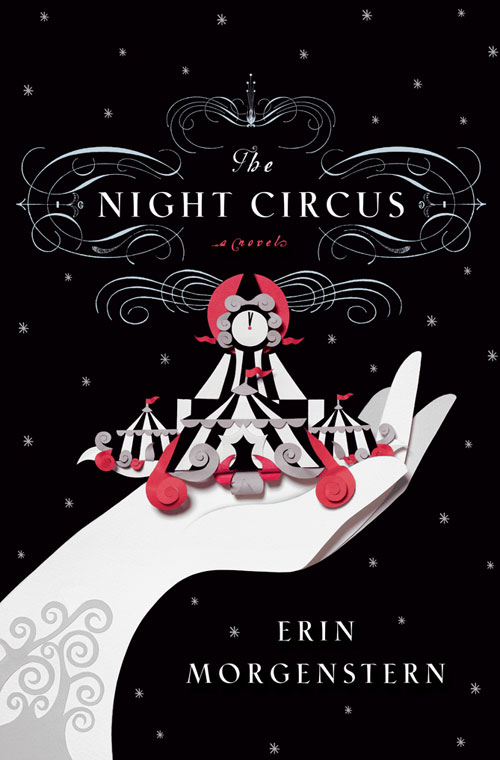
The Night Circus

Recently, The New York Times published "Your Brain on Fiction," an article that examined the neuroscience of reading imaginative literature, reporting that reading about smells and actions stimulates the brain in the same way that living those experiences does. In short, our brains treat the fiction as reality, showing that our long-standing metaphor of fiction bringing new worlds to life is, in terms of brain function, a literal as well as figurative truth. The article ends with the following lines: "Reading great literature, it has long been averred, enlarges and improves us as human beings. Brain science shows this claim is truer than we imagined."

A friend of mine forwarded The New York Times article to me as I was reading Erin Morgenstern's debut novel The Night Circus, and if there was ever an invented world you might be glad to descend into and live in a while, this is it. Morgenstern's novel is rich in precisely the kind of detail most likely to stimulate our minds: the dark caramel of a coated apple, the scent of popcorn on a clear night. Her novel imagines for us a circus more amazing than the most wonderful we've been to and brings the place to life through rich images that leave our mouths watering.

I've heard that the seeds for this novel began not with character or plot but with setting, the circus itself, and I believe it. Morgenstern peppers the novel with brief second person chapters that invite us in to new tents and passage ways. These moments reminded me strongly of Italo Calvino's Invisible Cities both in their image-driven beauty and their poetic language. (OK, maybe not quite so poetic as Calvino, but that would be setting the bar impossibly high, would it not? But they are rich and beautiful and finely wrought.)

What grounds the novel is the plot and characters that Morgenstern applied once she had created this amazing circus. Whereas Calvino's prose poetry collection is very loosely "plotted" with the story of Marco Polo explaining the places he's been to Kublai Khan, The Night Circus is more firmly grounded in a magicians' battle. Two children have been bound against their wills to compete for magical supremacy and the circus is their venue, the place where they test their skills against one another by creating ever more fantastical tents.

The result is a high interest page-turner with a literary quality, a novel that those who love fantasy and those who love language can enjoy equally.

Sunday, February 26, 2012

In Defense of Teaching Fantasy Writing

Speculative fiction is big in Utah. Writers Orson Scott Card, Brandon Sanderson, Brandon Mull, Stephanie Meyer, and many, many others have all called Utah home, and most of my Advanced Fiction writers are working on fantasy novels of their own, so perhaps it is unsurprising that in my first year here, I find myself teaching a course devoted exclusively to writers of Speculative Fiction.

I'll be bold and venture this generalization: most creative writing programs in the country look down on genre fiction in general and spec fiction in particular. Most graduate programs and many undergraduate programs will discourage their young writers from "wasting their talent" on writing sci fi or fantasy novels, and they have some good reasons for this, the best being that many writing students fall back on writing flat, stereotypical characters who follow expected plot points. Teachers argue that writers of genre fiction aren't challenging their imaginative abilities by creating something wholly new.

The problem with this argument is that it ignores the same pitfalls in literary fiction. I've heard agents complain about "MFA fiction," for example, by which I suppose they mean the beautifully written novel about nothing in particular. I've heard others complain that all MFA writers write about is cancer patients or self-absorbed twenty-somethings, the stock characters of literary fiction. I don't want to denigrate my peers by implying that these stereotypes are just; they may have some grounding in fact, but they overgeneralize. However, the best literary writers break from these stereotypes to write moving stories that get at core human truths. And therein lies the problem with the argument against allowing students to write genre fiction, because I would argue that the best spec fic aspires to the same purpose of illuminating what's best and worst about humanity.

When I began prepping my spec fic writing class, I was the first to admit that I'd shunned SF for quite some time and that I had quite a lot of reading to catch up on. I had read The Hobbit, LOTR, and waaaaaay back in my youth, the original Dragonlance trilogy, but I had no idea what SF looked like now. I asked my students, friends, and colleagues to help me generate a reading list, which included Neil Gaiman and Terry Pratchett's Good Omens, George R.R. Martin's Game of Thrones, Suzanne Collins's The Hunger Games, Joe Abercrombie, Brandon Sanderson, etc., etc., and what I quickly discovered was that my own assumptions about fantasy--and those of my colleagues--were well and truly out-moded. The best fantasy novels had long moved on from the stock character types of Dragonlance and into political dystopias with keen attention to plot. Good Omens was a romp, the voice of which kept me engaged from page one to the end. Gaiman's American Gods paired and inventive premise with an engaging literary writing style. The characters in Joe Abercrombie's Heroes were as complex and nuanced as any I'd read in literary fiction, and while I have some issues with George R.R. Martin's love of the word jackanapes and his need to cling to the phrase "game of thrones" once he'd discovered it, I can't fault his ability to offer compelling imagery or his deft juggling of multiple viewpoints over a sustained narrative.

I quickly realized too that I had read far more SF than I thought I had. Because Margaret Atwood and Neil Stephenson are often housed in the literary shelf at the bookstore, I hadn't thought of Oryx and Crake or Snowcrash when I assessed my own reading tastes as strictly literary. Acknowledging that the boundaries are far more permeable than we sometimes imagine, I quickly listed other spec fic novels: Gulliver's Travels, The Monk, The Mysteries of Udolfo, Frankenstein, Dracula, Alice in Wonderland and Through the Looking Glass, The Hitchhiker's Guide to the Galaxy, and so on. I realized that my friend Kirsten Kaschock's brilliant novel Sleight was speculative, as were the works of Italo Calvino, Aimee Bender, Anne Carson, and Franz Kafka. In short, I realized that "speculative fiction" is a false label wrongly associated with escapism and a sort of childishness, when many current SF writers are doing far more politically and artistically important work than is commonly acknowledged.Yes, there is still a good deal of bad writing out there, but the genre is deep with quality writers and writing.

Whether the average MFA program acknowledges it or not, speculative fiction is becoming a dominant literary form, not merely a pop genre. (Perhaps I should say "again becoming" since critics now acknowledge some of the best gothic fiction as literary.) The problems students encounter in trying to write spec fiction (hackneyed characters, insufficient attention to plot structure, etc) are common to all genres of writing including literary fiction, and the world building spec fic writers must do deepens their awareness of the necessity of setting and its affect on character and plot in ways that are deeply educational. There's enough to say on this point to write a whole post, but I'll stop there for now.

Thankfully, some writing programs, such as the one I teach in, are starting to be more open-minded and accepting, but the bias is still all too present. I had it myself. I'm glad to say, my students have educated me, and I have come to know better.